Chapter 39 — Equity and Redistribution of Income and Wealth
Cambridge International AS & A Level Economics (9708) · Unit 8.5 · 4th edition coursebook
Learning objectives
- Explain the difference between equity and equality.
- Explain the difference between equity and efficiency.
- Analyse the distinction between absolute poverty and relative poverty.
- Describe the poverty trap.
- Evaluate policies towards equity and equality such as negative income tax, universal benefits and means-tested benefits and universal basic income.
Key terms
- equality
- Where everyone is treated in the same way.
- extreme poverty
- Where a household exists on less than $1.90 a day.
- relative poverty
- Where household income is 50% or less than the average income.
- means-tested benefits
- Benefits that are paid only to those whose incomes fall below a certain level.
- poverty trap
- Where an individual or a family are better off on means-tested benefits rather than working.
- universal benefits
- Benefits available to all irrespective of income or wealth.
- universal basic income
- A regular unconditional cash payment made by the government.
- negative income tax
- Money paid out by the government to those earning below an agreed annual fixed benefit limit.
39.1Equity, equality and efficiency
Equity occurs when a society distributes its resources - income, government benefits, even wealth - fairly among its people. It has two aspects: horizontal equity, where consumers and others in the same circumstances should pay the same level of taxation, and vertical equity, where taxes should be fairly apportioned between the rich and the poor.
Equality is different. Equality means treating everyone in the same way. It aims to promote fairness, but it works only when everyone starts from the same position and needs the same help. It is the ideal of everyone being truly equal.
Efficiency (Section 32.1) means using scarce resources to produce maximum output. Economic efficiency requires firms to produce at the lowest possible cost and to produce the goods consumers most want. Markets often fail to deliver the best allocation of resources, so government intervention is needed to correct the failure.
Government failure can occur when policies that promote efficiency also increase inequality. Markets with negative production or consumption externalities are a typical case. A road pricing charge, for example, will reduce congestion (an efficiency gain) but it is regressive - a low-paid worker driving to work pays the same charge as a well-paid executive - so inequality rises. Equity and efficiency are therefore not the same: a policy can deliver one and worsen the other.
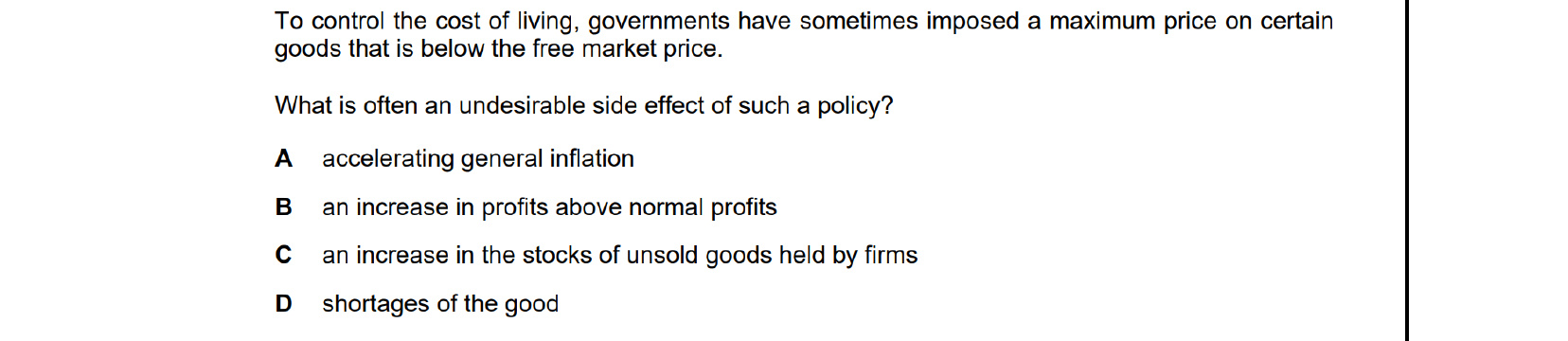
A maximum (ceiling) price set below the free-market equilibrium creates excess demand: at the lower controlled price quantity demanded exceeds quantity supplied. The classic undesirable side effect is therefore a shortage of the good (option D), often accompanied by queues, rationing or black markets.
39.2Absolute and relative poverty
Poverty exists when families lack the money or access to resources needed for a reasonable standard of living. This goes beyond food and housing to cover access to decent education, healthcare, water supply and sanitation. Although global poverty is falling, people born in poverty are still much more likely to remain poor - the 'cycle of poverty' - and the few who escape it are exceptions.
Extreme poverty
The World Bank defines extreme poverty as 'the international poverty line of living on less than $1.90 per day'. The number of people living in extreme poverty has fallen substantially in recent decades, largely because of strong economic growth in countries such as China, India, Indonesia, Ethiopia and Ghana, where extreme poverty has been roughly halved over twenty years. The remaining population in extreme poverty is now concentrated in Sub-Saharan Africa, and this concentration is forecast to persist.
Absolute poverty
Absolute poverty is when household income is below a level that makes it impossible for a person or family to meet basic needs such as food, housing, water, healthcare and education. Those in absolute poverty are unable to benefit from economic growth and rising living standards and are trapped in the cycle of poverty. The income level that counts as absolute poverty varies from country to country, so no single global value can be assigned to it.
Relative poverty
Relative poverty compares a household's income with the average income in their country. A household whose income is 50% or less of the country average is typically classed as in relative poverty. Such households have money for basic needs but not enough to enjoy the standard and quality of life of those above the threshold; access to consumer goods, housing and education is limited. A household can move out of relative poverty when members find jobs or better-paid jobs, often as a result of better education, and economic growth is an important factor.
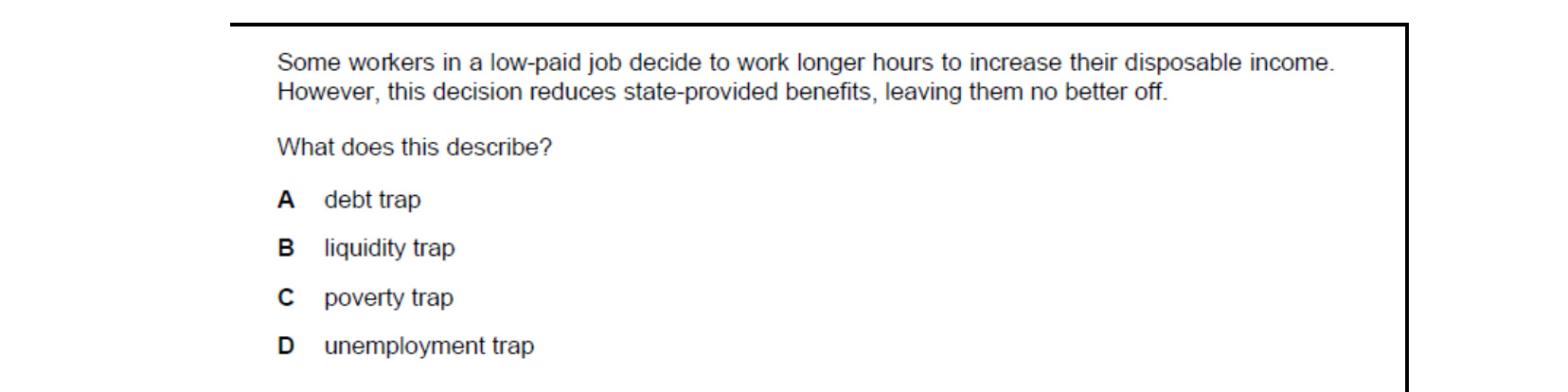
When working extra hours raises gross earnings but causes means-tested benefits to be withdrawn so quickly that disposable income does not rise, the worker faces a near-100% effective marginal tax rate. This disincentive is the poverty trap (option C) — distinct from a liquidity trap or a debt trap.
39.3Policies towards equity and equality
Section 14.4 analysed how fiscal policies and state provision can attempt to redistribute income and wealth. This section covers additional fiscal policies specifically aimed at equity and equality.
The poverty trap, benefits and universal basic income
One way to redistribute income is to pay benefits out of government spending to those on low incomes. Money raised through taxation is paid to low-income persons and families to raise their disposable income. There are three main types of such benefits:
Means-tested benefits
Means-tested benefits are paid only to those on low incomes, so they are targeted at those most in need. Examples include income support and unemployment benefit. What is available varies between countries, with high-income countries generally able to provide more because they have a more robust tax base. Means-tested benefits have two notable drawbacks. First, they are not always claimed by those for whom they are designed. Second, they can create a poverty trap - a disincentive to work in which a person or family is financially worse off when one or more members work than when the household lives off benefits. This can occur where a low income tax threshold is combined with generous means-tested benefits up to a certain income.
Universal benefits
Universal benefits are paid to everyone in certain categories - often age-related - regardless of income or wealth. Examples include universal state pensions and child benefit. Universal benefits overcome the two problems of means-testing (under-claiming and the poverty trap), but they pay money to many who do not need it and so are expensive to operate.
Universal basic income
Universal basic income is a relatively new form of benefit: an unconditional cash payment made at regular intervals by the government, regardless of earnings or employment status. The principal advantage is that it reduces poverty and income inequality while encouraging recipients to enter or stay in employment (there is no withdrawal as earnings rise). It also recognises the contribution of those managing families and caring for older people. Critics argue, as with universal benefits more broadly, that payments to people who do not need them divert resources from those who need extra help.
Negative income tax
Negative income tax is designed to deal with the weaknesses of means-tested and universal benefits. Under such a regime there is a flat rate of taxation (say 25%) and every person or family receives a fixed annual benefit (say $4000). If the tax paid on earnings is less than the annual benefit, the person receives the difference from the government - hence 'negative' income tax. Where the difference is positive (as with high earners), the person pays tax to the government as usual. Economists have long argued for this approach, but no country has yet implemented it as a complete system, mainly because of perceived practical problems.
Key concept link - The role of government and the issues of equality and equity
This chapter has shown that there is a growing range of opportunities for governments to achieve greater equality and equity. The reality is that few such opportunities are being applied, mainly due to problems of implementation.

Long-run income inequality narrows when more workers acquire the skills that earn higher wages. An increase in government spending on education and training (option B) raises the productivity and earning power of those previously at the bottom, shifting more workers up the income distribution and so reducing inequality.
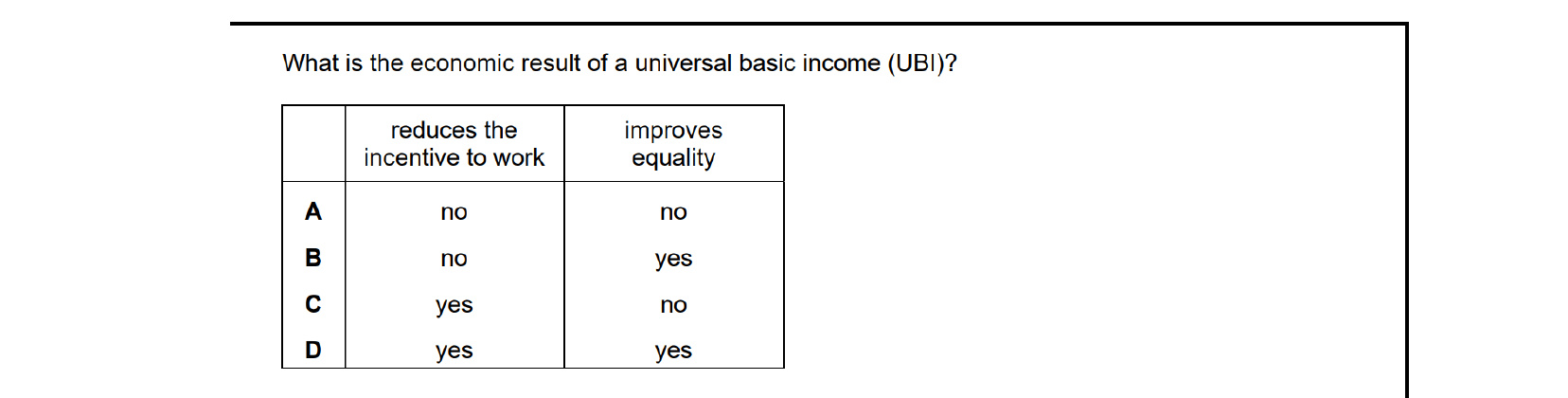
A universal basic income is paid to everyone regardless of earnings, so it is not withdrawn as income rises. Households therefore keep the full reward of extra work — the incentive to work is preserved (yes). The flat payment also raises the relative position of low-income households, improving income equality (yes). The result is option D — yes / yes.
End-of-chapter practice
Past-paper questions from CIE 9708. Pick A, B, C or D. Answers are saved on this device — press Download report (PDF) at the top to save them.
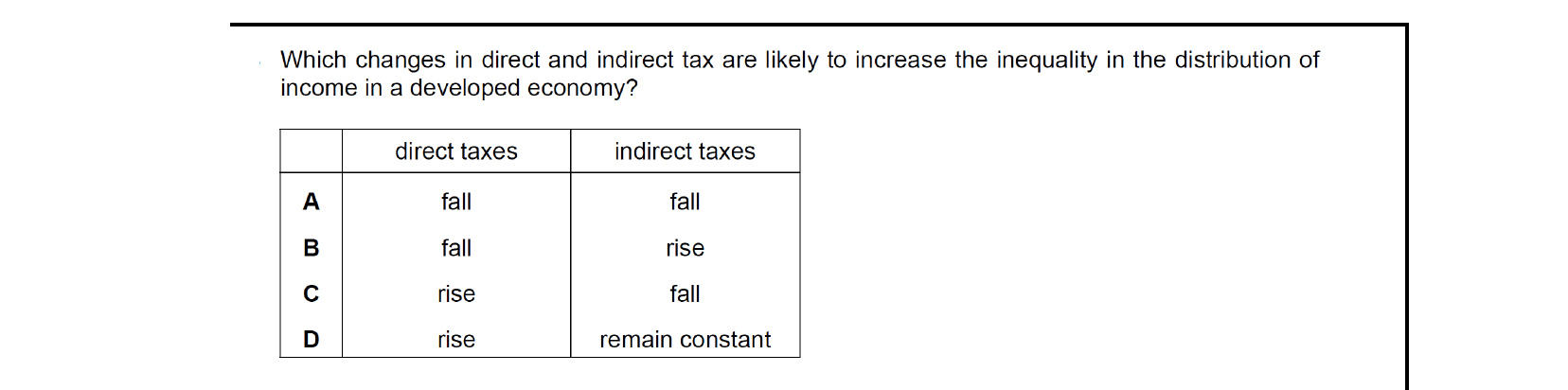
Direct (income) taxes are typically progressive — falling rates worsen inequality by letting high earners keep more. Indirect taxes (such as VAT) are usually regressive — rising rates take a bigger proportion of poor households' income. A fall in direct taxes combined with a rise in indirect taxes (option B) therefore unambiguously increases income inequality.

Inequality falls most when the tax system becomes more progressive on both fronts. Raising progressive direct taxation collects more from high earners; cutting indirect taxation reduces the regressive burden on the poor. Together (option B) the two changes redistribute income from rich to poor, reducing inequality.
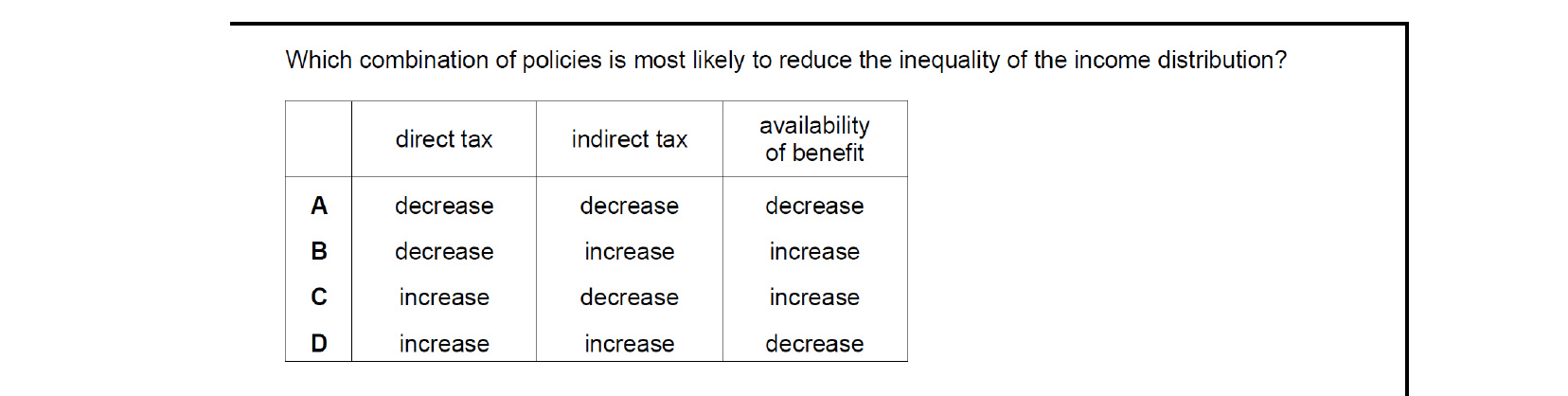
Inequality is reduced most when transfers are targeted to those on low incomes. Increasing means-tested benefits and the availability of universal basic income channels support to the poor, while decreasing universal benefits (which also go to higher-income recipients) avoids leakage. Option C — increase, decrease, increase — best targets redistribution.

Inter-generational equity concerns the relative welfare of different age groups. Raising educational maintenance allowances boosts the young while cutting state pensions reduces support for the old (option C) — the two measures together change the balance of income between generations, directly affecting inter-generational equity.

Equity is about fairness as judged by society, not literal equality of incomes or of opportunity. A distribution is equitable when society regards it as fair (option D) — that judgement may, but need not, coincide with equal wages, equal opportunities, or an exactly equal distribution of income.
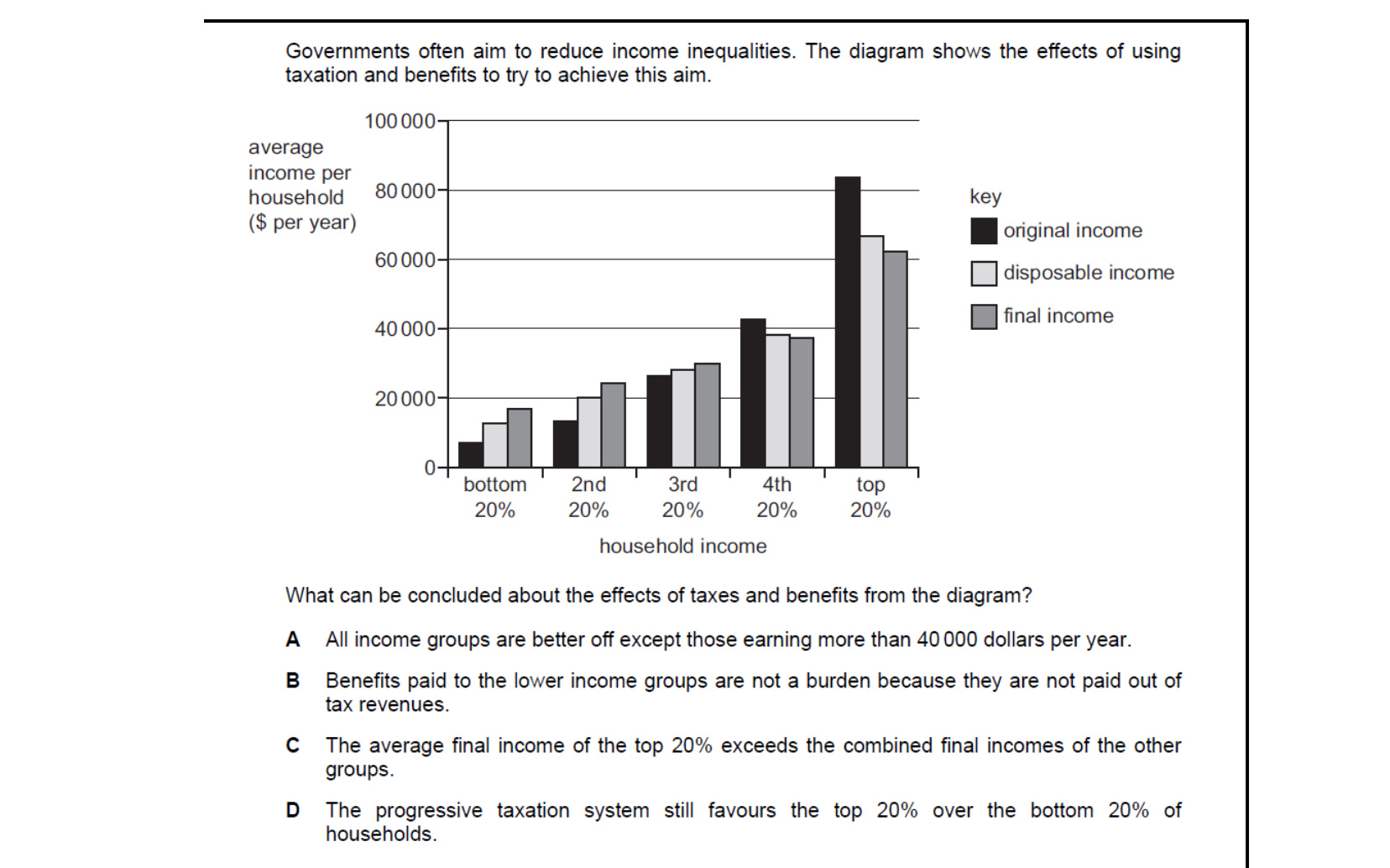
A universal basic income is paid unconditionally, so it is not withdrawn as earnings rise. It lifts the income of the poorest (reducing poverty and inequality) while leaving the marginal reward to work intact (preserving incentives). Option A captures this combination — reduced poverty and inequality with a positive work incentive.
Attempt the practice questions above to build your score.
Self-evaluation checklist
After studying this chapter, you should be able to:
- Explain the difference between equity and equality.
- Explain the difference between equity and efficiency.
- Explain the difference between absolute poverty and relative poverty.
- Understand the significance of the poverty trap.
- Evaluate how the government can use additional fiscal policies to attempt to redistribute income and wealth: means-tested and universal benefits, universal basic income, negative income tax.
Want more practice? Drill this chapter's past-paper MCQs (58 questions) →